Should a documented radiant heat repair on a Sunnyvale Eichler's disclosure statement make you feel better about the offer you're about to write, or worse?
Most buyers read it the first way. A past leak, fixed, with a paper trail, looks like proof the seller handled a problem and moved on. In a market where Sunnyvale Eichlers routinely draw multiple offers and buyers are told to come in with financing locked and a willingness to waive contingencies, a clean-looking disclosure line feels like one less thing to fight over. That reading is backward, and understanding why changes how you should structure your due diligence on any Eichler in this city.
A city built on one system that ages the same way everywhere
Sunnyvale holds roughly 1,100 Eichler homes spread across 16 tracts, more than any Bay Area city except Palo Alto. The names carry real local weight: Fairbrae and its later Fairbrae Addition, Fairwood and its own Addition, Rancho Verde and Rancho Verde Addition, Fairorchard, Midtown, Parmer Place, Primewood, Rancho Sans Souci, Fairpark Addition, and the original Sunnyvale Manor tracts where Joseph Eichler built his first scattered homes in 1949 before architect Robert Anshen joined him a year later to create the post-and-beam, glass-walled style the name now means.
Fairbrae still centers on the Fairbrae Swim and Racquet Club, a member pool and tennis club that has anchored that tract's social life since the homes went up between 1958 and 1961. Fairwood, built just after, sits close enough to Apple's campus that many buyers are Apple employees shortening a commute, and homes there occasionally sell before they're widely marketed. Fairorchard, built in 1954, today feeds into some of the most sought-after school assignments in the city.
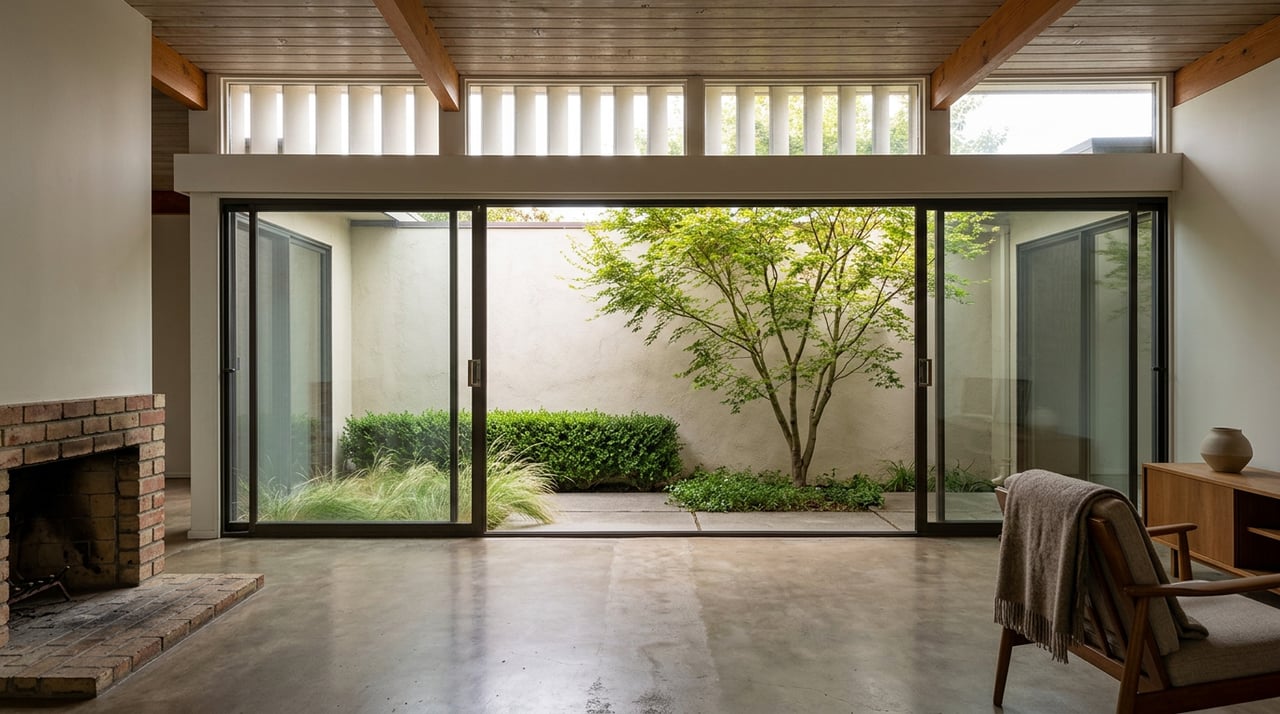
Every one of these homes shares the same underlying construction detail regardless of tract name or price point: a poured concrete slab with heating tubing embedded directly inside it, no ductwork, no radiators, just hot water circulating through pipe that has been sitting under your future living room floor since somewhere between 1949 and the early 1970s.
What's actually inside the slab
Eichler's radiant systems ran either copper or steel tubing through the concrete, and the material matters enormously to what happens next. Copper systems are generally repairable. The tubing itself lasts a long time, and when a leak does develop it's almost always because the slab cracked around the tube and stress at that crack point eventually caused the copper to fail, not because the copper itself degraded. Steel tube systems are a different story. Once a steel system starts leaking, that's typically active corrosion rather than isolated stress, and most specialists in this trade will tell a homeowner the system needs to be replaced with an alternative, most often hydronic baseboard, rather than patched.
For copper systems still in service, the pattern that specialty hydronic contractors report is a slab with somewhere between one and five leaks after 25 to 50 years of grade stress and settling, which is roughly what you'd expect from tract homes built with thinner, less uniform slabs than a custom home would have. Locating those leaks doesn't require tearing up the floor. Technicians typically pressurize the system, then use helium spectrographic detection or a hydrostatic pressure test, run at 45 to 100 PSI held for 45 minutes with no pressure loss allowed, to pinpoint the exact spot before a small jackhammer opens just enough concrete to repair it. According to Anderson Radiant Heating, which has specialized in this work for decades, a complete leak repair on a typical Eichler runs about $1,250 to $2,500, and a full whole-house repair should never need to exceed roughly $7,500. Homeowner's insurance sometimes reimburses close to 90 percent of that cost when it's tied to documented water damage and processed as non-plumbing work, though some carriers have started excluding radiant panel leaks from coverage altogether, which makes a call to your own agent worth making before you count on that offset.
What the disclosure form actually promises you
California's Civil Code Section 1102 requires sellers to complete a Transfer Disclosure Statement covering known material facts about the property, and the legal standard is actual knowledge, not an obligation to investigate. A seller who had a radiant leak repaired two years ago is required to disclose that repair even though the problem is fixed. What the form does not require, and cannot require, is testing a system that isn't currently showing symptoms. A seller with no warm floor spots, no unexplained water bill spike, and no ceiling stains has nothing to disclose because there's nothing to know yet, even if the same slab that produced one leak in 2024 is sitting under identical stress in 2026.
That's the piece worth sitting with. A documented repair on a TDS is a record of one failure event on a system that specialists already expect to produce multiple failures over its lifetime. Reading it as an all-clear treats a data point about ongoing stress as if it were a conclusion. If a seller later learns of new material facts, an amended disclosure is required. Open Exam Prep says that, depending on how it's delivered, a buyer typically has a window measured in a few days, commonly 3 days if hand-delivered or 5 if mailed, to review it and potentially cancel. That protection only works if you have time left in your contingency period to use it.
The gap between what a general inspector checks and what an Eichler needs
A standard home inspection covers the roof, structure, plumbing fixtures, and electrical systems, and does exactly what it's supposed to do for a typical resale home. It does not typically include pressurizing a slab heating system and running a helium leak detection pass. That's specialized work, historically handled by hydronic and boiler contractors under a C-4 license classification from the California State License Board precisely because locating a concealed leak in embedded tubing takes different equipment and training than a general home inspector carries.
Practically, that means an Eichler purchase needs two separate bookings inside the same contingency window: the general inspector, and a hydronic specialist who can test the radiant system specifically. Most standard contingency periods weren't built with a second specialist appointment in mind.
Where the market squeezes the exact step buyers need most
Sunnyvale's broader housing market has stayed fast into late summer 2026. Homes sold in a median of 13 days over the three months ending June 2026, and separate tracking as of July 31, 2026 put the typical time to pending at around 16 days, with many homes still closing above asking price. Inside the Eichler tracts specifically, buyers are routinely advised to arrive with financing fully lined up and a stated willingness to waive contingencies, because these homes can draw competing offers quickly once listed. Some tracts, Fairbrae and Rancho Verde among them, tend to sit at the higher end of that competitive range.
That's the friction point. The exact property type most likely to require a second, specialist inspection is sitting inside the exact market segment most likely to pressure a buyer into shortening or waiving the one contingency built to protect against it. A seller's disclosure telling you a leak was repaired doesn't remove that need. If anything, it's a reason to book the hydronic specialist before you're three days into a compressed window with a seller who has other offers on the table.
Frequently asked questions
Does a repaired radiant leak on the TDS mean the system is fine now? It means one leak was found and fixed. Given that copper systems in homes this age average one to five leaks over their lifetime, a documented repair is closer to an early data point than a clean bill of health for the rest of the slab.
Will insurance cover a new leak if one turns up after I own the home? Sometimes, and often around 90 percent of the repair cost when it's tied to documented water damage and processed as non-plumbing work. Some insurers have started excluding radiant panel leaks entirely, so confirming coverage with your own carrier before closing is worth the phone call.
Is one Sunnyvale Eichler tract riskier than another for this issue? Every tract in the city was built between 1949 and the early 1970s, so every Eichler here is now decades into the same slab-stress timeline regardless of neighborhood name. What differs tract to tract is community context, amenities like Fairbrae's swim club, school assignment, design guideline oversight, not the tubing itself.
Should I waive my inspection contingency to compete for a Sunnyvale Eichler? A sharper move than waiving it outright is shortening it and lining up a hydronic specialist before you're in contract, so the extra test doesn't blow a negotiated timeline once you're competing against other offers.
If you're weighing a Sunnyvale Eichler and want a second set of eyes on a disclosure statement before your contingency clock starts, VKG Real Estate Group can walk through it with you and help line up the right inspection order before you're already competing for the house.
This article is general information, not legal, tax or financial advice. Consult a qualified professional about your situation.